




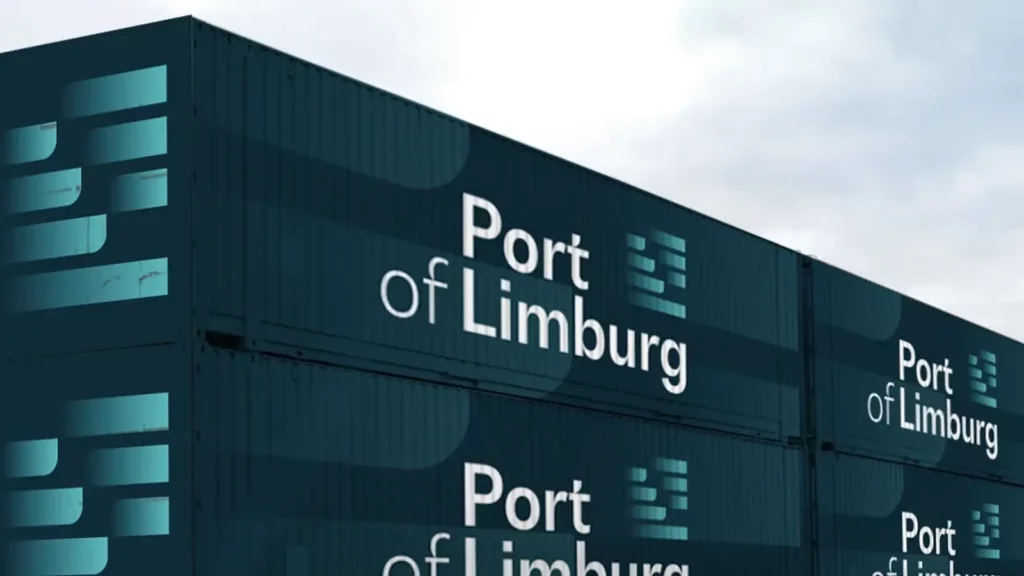
From an old Ford site to a brand new container terminal. Port of Limburg had to set up a completely new organization in no time. The financial administration also had to be ready for launch. So one thing was clear: there was especially a need for speed.
Today, Port of Limburg connects the hinterland of Genk with the ports of Antwerp and Rotterdam. Containers depart or arrive by inland waterway via the Albert Canal, are temporarily stored in Genk, and are delivered or picked up by truck.
A complex logistical operation that requires a lot of organization behind the scenes.
We spoke with Tim Berben, CFO of Port of Limburg, about the rapid start-up, the choice of Business Central, and the collaboration with scapta.
From container terminal to logistics hub
Tim, for those of you who don't know Port of Limburg yet: what exactly do you do?
“We are an inland container terminal that connects Genk with the hinterland and the ports of Antwerp and Rotterdam. We transport containers by inland vessels over the Albert Canal to and from our terminal. There we load and unload the containers by truck within a radius of about 50 kilometers around Genk.”
With about 35 employees, Port of Limburg mainly serves shipping companies and companies from the region that require container transport.
“A large part of our activity consists of avoiding transport by road. Instead of having containers transported between Genk and Antwerp, we transport them much more efficiently and more environmentally friendly using ships and in larger volumes.”
The terminal thus forms an important link between the region and the major seaports, with one clear ambition: more goods transported by water and fewer trucks on the road.
A new organization, therefore also new systems
Port of Limburg is still young. The plans for the reconversion and construction of the terminal were initiated several years ago. In March 2025, the operational activities effectively began.
But before the first containers could be processed, the organization behind the scenes also had to be ready.
“In mid-2024 we started building our systems. For the accounting we needed a solution that was fast, scalable, and flexible. For example, if you’re doing a large ERP implementation, you’re usually working for two years. We couldn’t afford that.”
The challenge was clear: a fully-fledged solution, but without years of implementation.
“We needed a plug-and-play solution that was quick to implement and suitable for an SME.”
— Tim Berben, Port of Limburg
Why Business Central?
Port of Limburg reviewed several software packages and partners. In the end, the choice fell on Microsoft Dynamics 365 Business Central, with scapta as the implementation partner.
An important asset? Business Central was already familiar within the Group Machiels environment, one of the shareholders of Port of Limburg. Therefore, there was already experience with the package that Port of Limburg could rely on. But that was not the only reason.
“We looked at several other partners. In the end, it was a combination of professionalism, the existing contact with our shareholders, and the price-quality ratio of the package.”
The way in which scapta provided support also played a decisive role.
“There were other parties that also offered software as a service and could switch quite quickly. But for example, not with the support we received from scapta.”
Business Central alongside operational ERP
A container terminal is of course not a classic SME. In addition to financial administration, Port of Limburg operates on a specialized ERP system for operational operations.
In it, all movements at the terminal are recorded: ships, trucks, machines, containers, and all operational activities. These data then form the basis for billing.
A completely new ERP system was therefore not an option. Business Central had to be seamlessly integrated with what was already in place.
“Our outgoing invoicing is done from the operational ERP system. There is a link to Business Central, so we can do the accounting in Business Central. The processing of incoming invoices is done directly in Business Central.”
In this way, both systems complement each other: the existing ERP for operational operations and Business Central for financial administration.
Ready for the start
The timing was tight. At the end of 2024, the systems were further developed, and on March 1, 2025, Port of Limburg began its operational activities.
For the implementation, the team could rely on Erwin Germeys, Business Central consultant at scapta. He guided Tim and Joanna, General Accountant at Port of Limburg, in the development of the environment and ensured that Business Central was ready for launch together with the team.
“That was tough. I did the first build-up together with Erwin, but I’m not a bookkeeper myself.”
Also within Port of Limburg, different expertise came together. Tim brought mainly business experience, while Joanna had the necessary accounting knowledge and experience.
“It was actually a mix-and-match situation. One had a lot of business experience and less accounting knowledge, the other just the opposite. Erwin managed to smooth that out beautifully.”
There wasn't much time to get used to the system at a leisurely pace.

From learning to work to optimizing yourself
Today, about seven end users are working with Business Central. The financial administration is fully integrated into the system, and management also uses it, among other things, for the approval process.
The first few months were mainly focused on learning to work with the new environment. And the support from scapta came in handy here.
“I’ve been very involved in supporting the scapta, and I still do that for some things. But the more I work on it, the more I can take it out of the system myself.”
— Joanna Louwette, Port of Limburg
Ready for the next step
The foundation is in place. Business Central forms the financial backbone today and users are getting to know the system better and better. This learning curve is clearly noticeable.
“I can almost work blindly with the program.”
Joanna Louwette, Port of Limburg
What began as a system that primarily had to work is gradually becoming an environment where Port of Limburg can increasingly do things on its own.
This creates room for the next challenge: better reporting, automation, and further optimization. The possibilities of Power BI are also considered in this context.
“We are now at the point where we have the space to strengthen reporting and start doing automation.”
For Port of Limburg, the implementation was not the end point. On the contrary: now that the foundation is in place, there is room to build further.